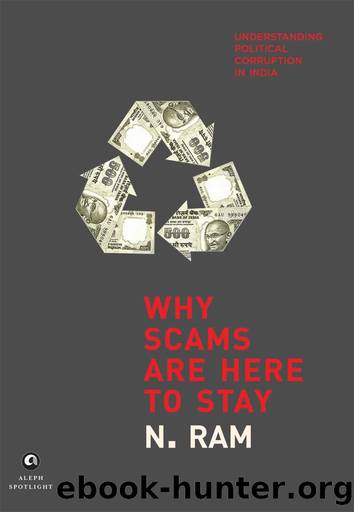
Why Scams are Here to Stay: Understanding Political Corruption in India by N. Ram
Author:N. Ram
Language: eng
Format: azw3, epub
Publisher: Aleph Book Company
Published: 2017-07-07T16:00:00+00:00
âBut what good came of it at last?â9
Little Peterkinâs meaningful question to Old Kaspar in Robert Southeyâs anti-war poem is worth asking about the investigation into the Bofors corruption scandal.
The answer must necessarily be complex, nuanced, and inconclusive. There is little doubt that Bofors and The Hinduâs investigation and exposé, which was triggered by the Dagens Eko broadcast of 16 April 1987, made a big political impact, the kind of impact that no single corruption case has made in India before and after Bofors. Investigative journalism played the lead role in bringing the truth to light but it would be a mistake to think that the impact was the contribution of journalism alone. It was the political opposition spearheaded by V. P. Singh that took the work of journalism far and wide, deep into society and the polity, and developed it into a major election campaign theme.
Let me digress a little here on investigative journalism and the question of impact. Every journalist working determinedly to unearth the truth desires impact. The success of investigative journalism is often judged by whether it is able to generate change in the desired direction. But there are obvious problems with applying this criterion. For one thing, it exaggerates the role the news media play, assigning to them a power to shape the larger external environment that they clearly do not have. Secondly, the impact of journalism on complex socio-economic and political realities is extremely hard to measure. Even in the case of the most celebrated journalistic investigation of the last fifty years, Watergate, the jury is still out on whether it made any real difference to politics in the United States and it would be an exaggeration to say that âit brought down a Presidentâ.
One part of the answer to little Peterkinâs question, as it applies to Bofors, is that what prevailed at the bar of public opinion and politics failed and eventually collapsed at the bar of public prosecution. The cover-up strategy adopted by the Indian and Swedish governments between 1987 and 1989 meant that the investigators faced an uphill task after a criminal case was registered by the CBI in January 1990, nearly three years after Dagens Eko broadcast the allegations. Evidence that could have been collected from Bofors AB and the Swedish investigators had a case been registered by an independent-minded CBI in April 1987, or at least after The Hindu published the first set of documents in April 1988, was irremediably lost. Moreover, the cover-up and damage limitation efforts were resumed when the Congress, headed by P. V. Narasimha Rao, formed a minority government in 1991, and once again after a rejuvenated Congress returned to power at the head of a new coalition, the United Progressive Alliance, in 2004.
As the Bofors corruption case slowly made its way through the courts and the administrative-bureaucratic processes in India and Switzerland, the main accused, Rajiv Gandhi, was assassinated (on 21 May 1991, halfway through the 10th Lok Sabha election). A decade later, two other key accused, S.
Download
Why Scams are Here to Stay: Understanding Political Corruption in India by N. Ram.epub
This site does not store any files on its server. We only index and link to content provided by other sites. Please contact the content providers to delete copyright contents if any and email us, we'll remove relevant links or contents immediately.
| Anthropology | Archaeology |
| Philosophy | Politics & Government |
| Social Sciences | Sociology |
| Women's Studies |
The Secret History by Donna Tartt(19466)
The Social Justice Warrior Handbook by Lisa De Pasquale(12291)
Thirteen Reasons Why by Jay Asher(9110)
This Is How You Lose Her by Junot Diaz(7054)
Weapons of Math Destruction by Cathy O'Neil(6465)
Zero to One by Peter Thiel(5943)
Beartown by Fredrik Backman(5928)
The Myth of the Strong Leader by Archie Brown(5623)
The Fire Next Time by James Baldwin(5579)
How Democracies Die by Steven Levitsky & Daniel Ziblatt(5321)
Promise Me, Dad by Joe Biden(5228)
Stone's Rules by Roger Stone(5185)
A Higher Loyalty: Truth, Lies, and Leadership by James Comey(5082)
100 Deadly Skills by Clint Emerson(5023)
Rise and Kill First by Ronen Bergman(4890)
Secrecy World by Jake Bernstein(4870)
The David Icke Guide to the Global Conspiracy (and how to end it) by David Icke(4842)
The Doomsday Machine by Daniel Ellsberg(4618)
The Farm by Tom Rob Smith(4604)
